If you can't get on board with the patriarchy, you don't have a place in this orbit
Or, thoughts on the second night of camp, when God the Father is introduced

It’s Women’s History Month!
Just as the invitation to celebrate, honor, and remember Black Americans extends beyond the month of February (into eleven other months of the year), the invitation to also celebrate, honor, and remember the women among us is something that can happen every day of the year!
As it goes, I’m only three sentences into this post and exclamation points already dot every sentence — I mean, exclamation points already dot every sentence!
But the imperative is real: We get to celebrate the impact women have had and continue to have on our country.
In Church Camp, I was honored to interview and tell the stories of dozens of women. You’ll meet Kristen, a reality television producer who learned how to make good television as a result of camp. You’ll meet Olivia, who started attending camp when she was eight years old and didn’t leave until her late thirties — but who also remembers throwing her pine cone into the fire, year after year (as a way of acknowledging and “throwing away” her sin), and was then left wondering about the emotional manipulation of it all. And you’ll meet Sumiko, a self-described “4’11” Asian woman youth pastor” who spent four decades in the SBC (Southern Baptist Convention) before realizing that God really did look like her (at an SBC camp, no less) and not like the white male God she had long believed in.
Their stories are powerful, no doubt, and these are but three of the women you’ll get to know in the pages of my book.
But sometimes celebrating women also means calling out “all the ways men hold more power than women and are valued more highly,” as
defines it in her book Nice Churchy Patriarchy.
As you well know by now, Church Camp is organized by the seven nights at camp — in other words, by the talks I gave at different white evangelical church camps for nearly two decades. And the second night of camp was always an invitation to get to know (and embrace and come to believe in) God the Father.
The messages had to be set up as such in order to follow the progression of the Four Spiritual Laws, because “in this scenario, if you ascribe to a theology of human depravity, then you believe God’s deep love for humanity must live alongside (a male) God’s answer to the cost of sin”.1 As a speaker, “I had to paint a picture of the Loving Father — this singular image the sun, moon, and stars on which everything hung. Without it, everything else crumbled.”2
But in doing this, a singular image of God was captured and portrayed:
Because when the only image of God campers see is a white, male fatherly figure, then those who aren’t white and male (and who won’t, assumedly, ever see themselves as a father) can’t see God in themselves, nor can they see how they might ever come to be made in this God’s image. They don’t fit the mold. They can’t ever find an ultimate place of belonging because the image of a white man whose sperm may have fathered a child too easily evokes memories of exclusion, abandonment, and abuse of power, to name a few.3
It’s after this naming that we meet a couple of women who speak directly to their experiences as campers, in light of the patriarchy.
Readers meet Tiffany, whose experiences at camp as a transracial adoptee in an Assemblies of God environment meant that when it came to the “whole Father-Son narrative, it left out anyone who felt like leftovers, whose fathers didn’t want them, or whose personal experience didn’t fit into this story.”4 With no room for acceptance in a storyline that wasn’t about her, Tiffany felt like she was always on the outside looking in: “If campers — or staff members, for that matter — couldn’t get on board with the concept of God as Father, then you just didn’t get it, and you just didn’t get in.”5
She summed it up in a single, powerful sentence: “If you couldn’t get on board with the patriarchy, you didn’t have a place in this orbit.”6
It was the same for Caz, a New Zealander who lost her father at a young age. At a church camp designed to help the families of widowed, single mothers, Caz shared this memory:
No one held my questions with me; [they] just gave me answers. I distinctly remember one day someone talking about how our dads love us. And I remember thinking, Well, if that’s true, then I can never know God’s love.7
The message, of course, is not merely limited to the stage but it also embeds itself within this particular subset of white evangelicalism. Here, a man is not questioned about his ability to speak at camp, nor is he told there are certain roles for which he lacks qualifications. Need I state the obvious, that the same is not true for women?8
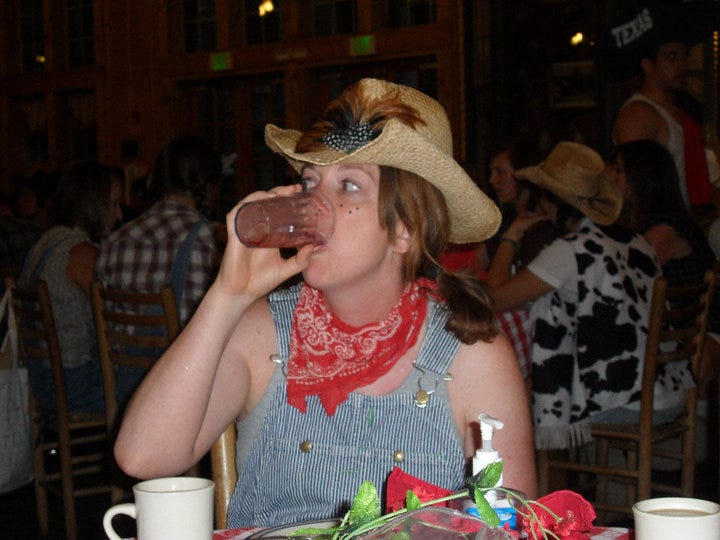
In this environment, “complementarian systems are often hierarchical and connected to power dynamics,”9 and here, purity culture comes out to play in full force. Take the one-piece bathing suit rule, for example, whose underlying purpose across Christendom is to not make the boys stumble: “Whether campers or staff members, the onus for young girls and women to protect their ‘brothers in Christ’ lay entirely on them — because in this movement, it was the women’s body that caused the man’s mind to stray.”10
In the church camp world, we further see purity culture play out through a host of bad skits and questionable illustrations — and to
, author of Preparing for War, “the basic tenants of purity culture are only one step down from a ‘racialized and nationalistic view of marriage, sex, and the family.’”11I’m giving you a very broad overview of Chapter 2, the second night at camp, but if I can say one more thing, it’s to ask a question of reimagining.
What does it mean to reimagine a God who is “neither male nor female but is instead revealed as being, Spirit, and imaged in both male and female”?12
How would this change experiences within white evangelicalism, church camps included, for both women and men? And as a result, how might this reimagining begin to flip over tables constructed and nailed together by the patriarchy?
It’s a question I hope we all stop to consider.
PS: Preorder a copy of Church Camp yet if you haven’t already, would you? Also, I wrote in a couple of different places this last week, most notably inviting the Church to get angry already over at Baptist News Global. Check it out!
Church Camp, page 35.
Church Camp, page 36.
Church Camp, page 37.
Church Camp, page 38.
Church Camp, page 39.
Church Camp, page 39.
Church Camp, page 40.
I provide multiple examples of how complementation belief systems play out in a white evangelical camp setting in the book. Here, it is a mere sentence.
Church Camp, page 44.
Church Camp, page 45.
Church Camp, page 49.
Church Camp, page 51.
Thanks for the shout-out, and a wholehearted yes to reimagining a God whose image is reflected in people of all genders! The "if you can't get on board with the patriarchy..." quote is so powerful, as is the quote from the camper who felt that no one was willing to hold her questions with her...
When I lead the singing for our kids church camp, I also show pictures with the lyrics. “God loves you and made you for the pleasure of knowing you. 🎶” The images are of mothers, fathers and grandparents holding children or interacting with them affectionately. At first, I wondered if this would be considered too radical, but nobody has pushed back. And now I can’t imagine depicting God in any other way.