12 things I recently learned about St. Hildegard of Bingen
Because, she's my girl. But first, a little story.

With ordination a few weeks ago came a lot of love — including the sweetest note and unexpected gift from my two dearest writing pals.
The three of us meet monthly to chat and encourage, critique and problem-solve, walk alongside and help one another make magic in the writing sphere (and, let’s be honest, in life as a whole) happen. Even though most of my queries have to do with getting words onto a page — How do I finish the middle grade novel I’ve been writing for the last five years? How do I make Substack happen on the weekly? How do I find a balance between all the many things that call my name? — they’ve also heard it all with the ordination process.
They’ve believed in me, that this too was the next right thing, that this would come to fruition. They call me a theologian, artist, writer, speaker, mama, wife, gardener, and now deacon — just as they call Hildegard a writer, gardener, and conservationist, a mystic, and a preacher.
Like her, they know Hildegard came to her greatest works in the middle of her life, unleashing “her wild, wise imagination with everything she had in her.” They can’t help but see and want and believe in the same for me.
I’m clinging to their words spoken over me, worn on me, as I get to know my girl, St. Hildegard of Bingen.
Get to know her with me too?
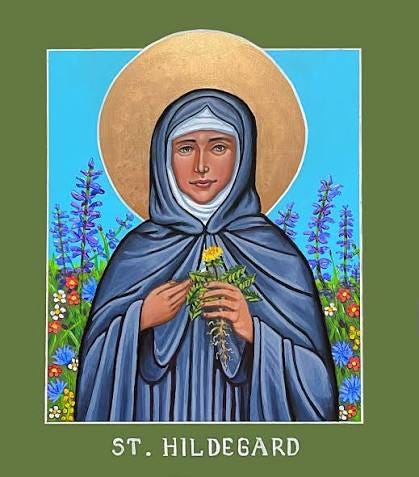
This woman did it all. Abbess, artist, author, composer, mystic, pharmacist, poet, preacher, and theologian,1 it’s almost like we should instead ask, what didn’t the woman do? Because for those of us who thrive on a bit of vocational variety, the variety can feel rather fitting.
Let’s not forget she also made significant contributions to medicine and botany, mostly in the realm of holistic healing. When it comes to the herbs many of us can find in our gardens now, I love what she said about lavender (lavendula): “If a person has many lice, let the person smell lavender frequently; the lice will die. And its smell clears the eyes since it contains the power of the strongest aromas and the usefulness of the bitterest one.”
She wasn’t afraid to rain down a little terror on the local bishops. In The Modern Saints,2 Meghan Tschanz writes that Hildegard “became known for her fiery speeches, in which she did not shy away from calling out corrupt religious leaders, authorities who abused their power, and the religious elite who sat back and enjoyed their wealth and status instead of getting into the communities to minister to those Christ commanded us to serve.”
As a writer, she made bold use of exclamation points. You can see this in a number of her poems, but I love how we see it in the first two words of “Antiphon for the Angels”: “Spirited light!” That’s what she called the angels, exclamation point!
She called the Spirit of God she. Perhaps this is not a big deal to you: the third person of the trinity is found in the Divine Feminine. Always has been, always will be. Or perhaps this is a big deal for you: aren’t all three persons of the trinity males? Don’t we hear a lot of “he’s” in the church today? Whoever you are, wherever you land, “scrubbing out sin, she rubs oil into wounds.” To Hildegarde, the Spirit of God was female, just as Sophia (or Divine Wisdom3) was female too. Of her:
She is glistening life
alluring all praise,
all-awakening,
all-resurrecting.4
She is the fourth woman in history to have been named a Doctor of the Universal Church. Pope Benedict XVI did the honors in 2012, noting “the presence of women in the Church and in society is also illumined by her presence, both from the perspective of scientific research and that of pastoral activity.”5
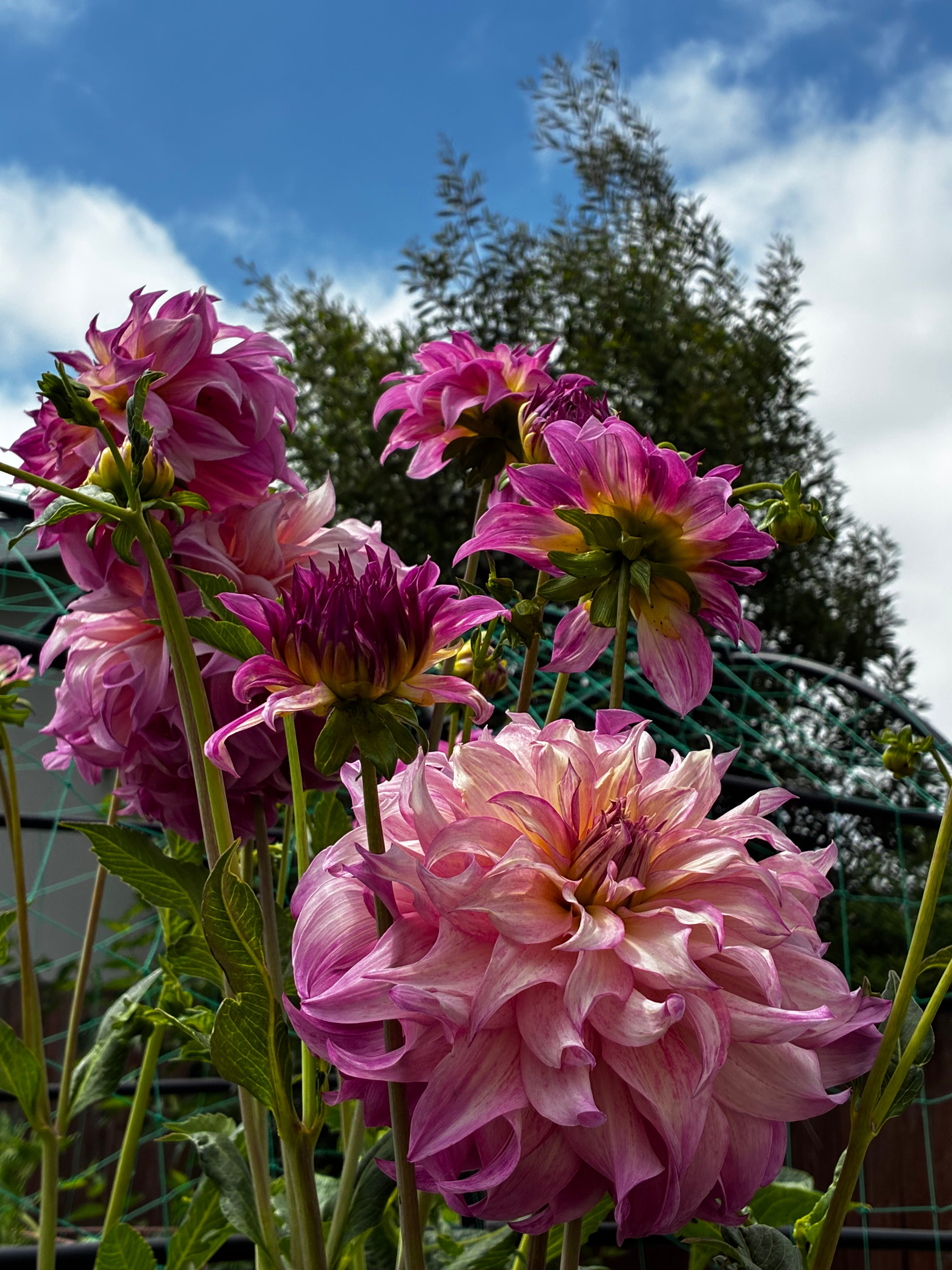
She was a deep fan of all things creation. Perhaps this comes as no surprise, considering her love for and belief in holistic healing, but when I read a line like, “All of creation is song in praise to God,” I can’t help but stare at the dahlias, the marigolds, the zinnias just a little bit longer and wonder about a different song of praise. After all, “your power like a wheel around the world, whose circling never began and never slides to an end.”6 I mean, can you blame me?
But of creation, she also saw its future destruction. Tschanz notes that she “had visions of air pollution and deforestation that would devastate the planet and advocated that we as humans take care of the land we live on.”7 Anyone know if there’s a children’s book on Hildegard we can pass along to the VP for an awkward read-aloud?8
Let’s not forget that the woman knew how to have a little fun. Did you know that “she was perhaps the first writer to speak about women’s sexuality in a positive light, writing the first description of the female orgasm”?9 Of this description, there’s a whole lot of talk of the word “seed,”10 which I’m not going to drop here — so can we instead talk about how such visions took place while in intimate marriage to the big G-O-D?
As Shannon K. Evans writes in her book, The Mystics Would Like a Word (and as I mentioned previously), Hildegard was a woman who stepped into her power at mid-life. Even though she had been having visions since she was a child, when she was 43, “she consulted her confessor, who in turn reported the matter to the archbishop of Mainz. A committee of theologians subsequently confirmed the authenticity of Hildegard’s visions, and a monk was appointed to help her record them in writing.”11 I can’t help but find similarities with “a woman who found her voice as a mystic and leader and then flourished with productivity” later in life.”12 Same, same, as the kids would say.
She was a visionary. I mean, literally, the woman had visions (and subsequently wrote three volumes of visionary theology). That’s one of the things she was most known for — as evidenced by the many times I’ve referred to “visions” throughout this list. Want to read one of her visions, just to make sure it’s visionary? Here you go: “And it came to pass ... when I was 42 years and 7 months old, that the heavens were opened and a blinding light of exceptional brilliance flowed through my entire brain. And so it kindled my whole heart and breast like a flame, not burning but warming.”13
Finally, she couldn’t help but see the magic in all those humans around her. The woman’s “visions caused her to see humans as ‘living sparks’ of God’s love, coming from God as daylight comes from the sun.” If that’s not cause for celebration, I don’t know what is.
So, tell me: Do you have any favorite books or podcasts about Hildegard of Bingen? I’m all ears, because she is, after all, my girl.
Be well, living spark,
C.
Thanks, Franciscan Media.
Page 97. Side note: I also have an essay in this book!
Don’t believe me? Check out “Antiphone for Divine Wisdom.”
Is that not everything? From “Antiphone for the Holy Spirit”
The Holy See. But also, seeing as 34 men have been canonized Doctor of the Universal Church, we have a little bit of catching up to do. Come on, Leo!
“Song to the Creator.” Also, for all those churches gearing up to celebrate the Season of Creation in September, might I suggest showing our girl Hildegard some love?
The Modern Saints, page 97.
Oh look, here’s one!
The Modern Saints, page 97.
And it’s therefore limited to female-male unions.
Thanks, Brittanica.
From Micha Boyett’s lyrical Substack.
Thanks, Poetry Foundation.
Looooove!
Yaas love her! Loved the way Shannon K Evans writes about her in The Mystics Would Like a Word too. So good, so healing.
Also enjoyed reading Mirabai Starr's reflections on Hildegard in Wild Mercy (a book you might really enjoy if you haven't come across it yet!).